Findings
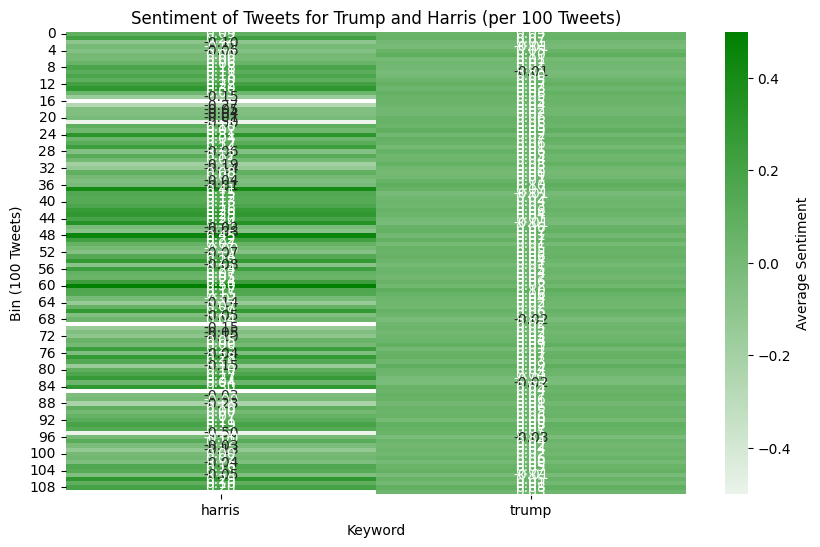
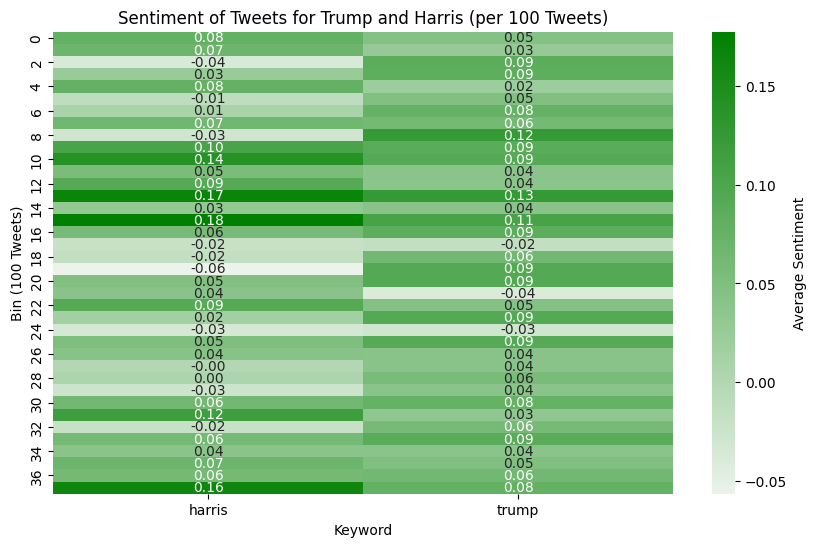
Overtime, hashtags used to both express support and contempt for both major presidential candidates Trump and Harris grew more specific and targeted, both positive and negative hashtags mentioning the candidates names more frequently. Through the heatmap visualization we can see that sentiment scores for Harris and Trump in the dataset became much more polarized with time, increasing leading up to the election. We can also see that as hashtag use in Tweets mentioning Trump increased overtime, use among Tweets mentioning Harris decreased. It can be drawn from these findings that Harris became discussed more frequently from May to August, before and after she was announced as the democratic nominee. It can also be gathered that Trump and Biden remained points of discussion on X throughout the entire election, Biden notably even after he stepped down from the nomination for democratic candidate.
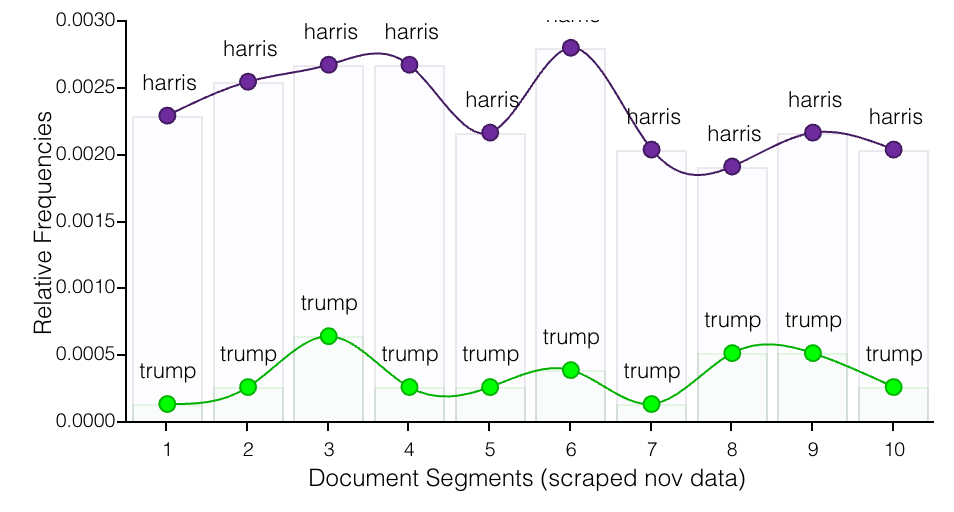
This research finds that overtime, engagement among X users with the phrase “harris” increased. She was mentioned in the data from May 503 times and the data from August 1831 times, more than a 300% increase. The word clouds created in Voyant echo this, with the words, “Harris,” “Kamala,” and, “she,” becoming more consistent in August where they did not appear in May.
DISCUSSION
It is worth starting the discussion of the data gathered in this research by examining the demographics of voters in the 2024 election. According to AP Votecast data, 57% of Harris voters were between the ages of 30 and 65. This age distribution remained the same for Trump (AP Votecast 2024). According to a survey of 5,101 American social media users conducted by the Pew research center in 2023, 46% said they had been politically active on social media in the last year. However, “clear majorities of Americans overall say the statement that “social media distracts people from issues that are truly important” (82%) or “makes people think they’re making a difference when they really aren’t” (76%) describes social media very or somewhat well,” (Pew 2023). Among X users, Semrush finds that 57.6% are between the ages of 18-34, and only 34% are between the ages of 35 and 65, the voters who most participated in the 2024 election. So, there is a discrepancy between the population that had the most influence in the 2024 election and the population that spent the most time viewing political content on X.
Moreover, there are limitations to the data gathered in this research. Because of the American electoral college system, a voter’s location and county of residence matter greatly when it comes to the impact of their vote (AP Votecast 2024). Because the location values were null in the dataset I used and cleaned out, we cannot track the locations of the most popular tweets discovered. My research also relies on Python III’s sentiment analysis. I gathered sentiment using Textblob, a Python III library that is known to have limitations in understanding complex emotions and slang. A further limitation is not having the specific date and timestamp for all tweets, merely the time frame they were scraped, which limits my ability to specifically see how interaction online varied overtime.
However, the data still provides key insights that answer the driving question behind this project: how did sentiment and discourse surrounding candidate Kamala Harris on X change from May 1st to November 5th, 2024?
The first answer is that she was discussed much more frequently, and with increasing polarity and sharpness of attack, overtime. The visualizations displayed suggest that as the campaign went on, sentiment expressed about her in tweets had much more variance in scores, as indicated by the heat map. The visualizations also provide interesting insight into the most popular content on X. They demonstrate that a hashtag does not always guarantee increased engagement, in fact engagement with hashtagged tweets decreased over the course of the election cycle. The specificity and target of hashtags is worth examining, however.
Two of the most popular hashtags used in tweets with negative sentiment scores for “harris” were “#comradekamala,” and “#kabamala.” These tweets represent two different conspiracy theories circulating the democratic party and propagated by right leaning online discussion. #Kabamala is in reference to the Q-anon conspiracy that posits key members of the democratic party make up a cabal of blood-thirsty pedophiles who are trying to takeover the US government. The theory has been disproven, and information about it has been restricted on several social media platforms, though the CEO of X Elon Musk has removed some of these restrictions since purchasing the platform in 2023 (O’Sullivan 2024).
The hashtag, ‘#comradekamala’ was introduced by Musk himself in September, when he posted an AI generated image of Kamala Harris on X in which she was wearing a red communist uniform according to CNN news (O’Sullivan 2024). Though the image violated X’s community guidelines, it was left up.
The image is one of many that were created during the time period these tweets were scraped. According to the voter mobilization nonprofit All In Together, which seeks to mobilize female voters across the United States, a set of data scraped from X between September 23rd, 2024 and September 29th, 2024 revealed 5,294 unique public posts and 22,485 public posts, replies, and shares on Twitter/X, Instagram, and TikTok containing racist and/or gendered attacks against Kamala Harris with a possible reach of 321 million accounts, with 8,037 unique public posts fighting back against these attacks. The nonprofit uses their own API, the Infegy Atlas consumer intelligence platform, to analyze text from online conversation and deem it as racially or sexually charged.
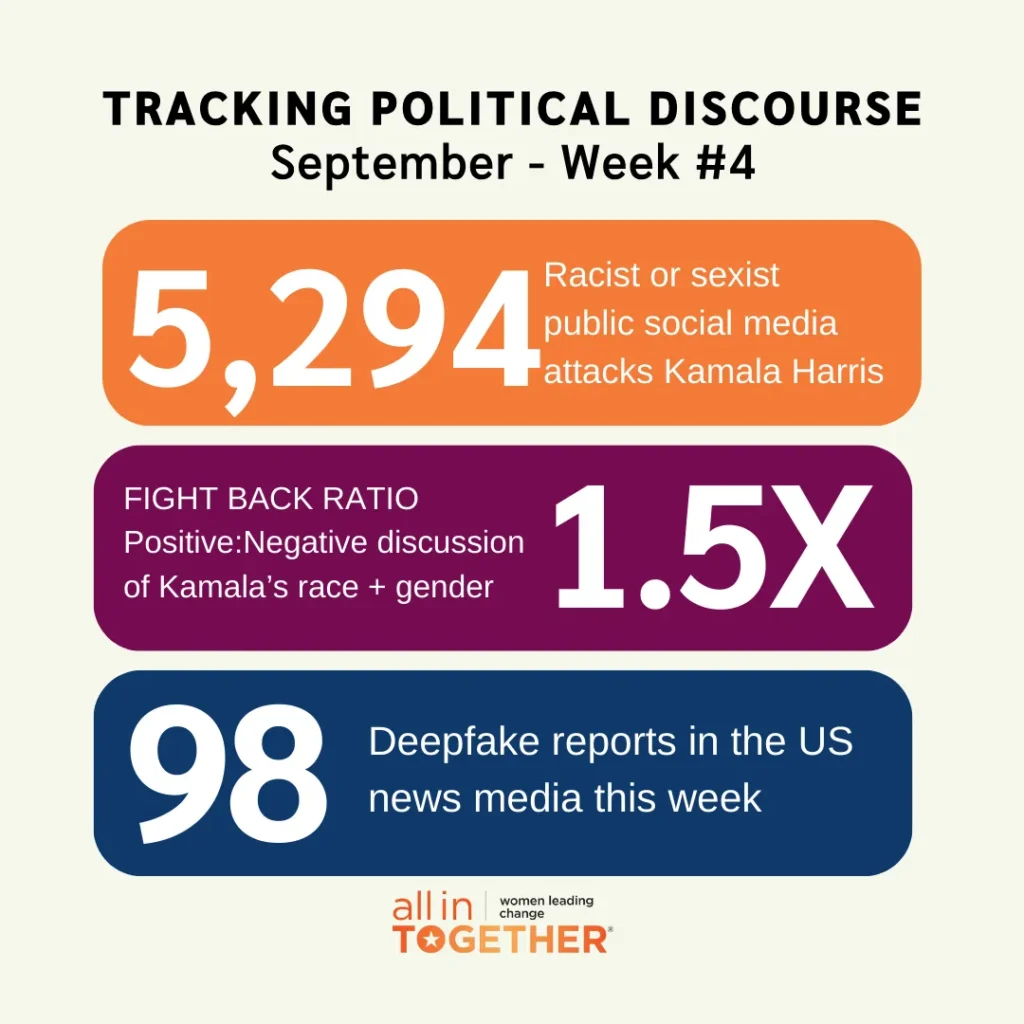
So racially and sexually charged images and targeted hashtags did well on X during the timeframe of the 2024 presidential campaign examined in the dataset. Though there is no one reason for this, examining the existing literature on possible algorithmic bias on X provides us with some solutions.
Regardless of political persuasion, hashtags used were intended to derive reaction from their audience. The use of #trump2024 as the most popular hashtag in tweets with positive sentiment for Harris is especially notable. This could be the phenomenon that Garimella et. al deem “hashtag hijacking,” where, “Users from opposing political camps engage in political ‘hashtag wars’ to obtain control over the terms being used,” (Garimella et. al 1). Hashtag hijacking poses unique challenges for analyzing voter sentiment through hashtags directly.
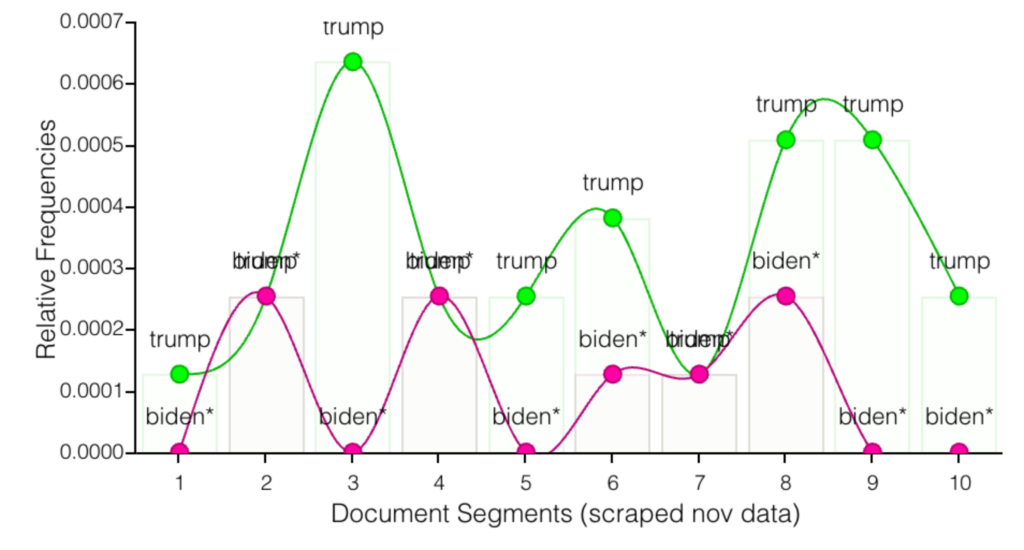
Looking at the most popular language used provides other insights. Over the course of the campaign, Harris was mentioned more directly by X users (Fig. 5). However, so was Biden. He remained the most mentioned term in both May and August, at 20520 times in May and 2306 times in August. But shifting to November, tweets that mention Harris do not all mention Biden as well, in fact he is mentioned less frequently than Trump in the dataset. This demonstrates a shift from her association with Biden as his sitting Vice President and Vice Presidential nominee to her independent campaign that was waged towards the end of the election cycle specifically.
But what does this data look like in the context of who actually voted in the 2024 election? According to the Pew research center, social media political engagement correlates greatly with race. “Black users stand out for their activity on social media, with a majority (58%) saying they’ve participated in [civic engagement] activities in the past year, compared with less than half each among White (45%) and Hispanic (40%) users,” (Pew center 2023). According to AP Votecast, 86 percent of Black voters voted for Harris, while 12 percent voted for Trump. This is one point down from the 87 percent who voted for Biden, but the Black vote made up much of both candidates’ support.
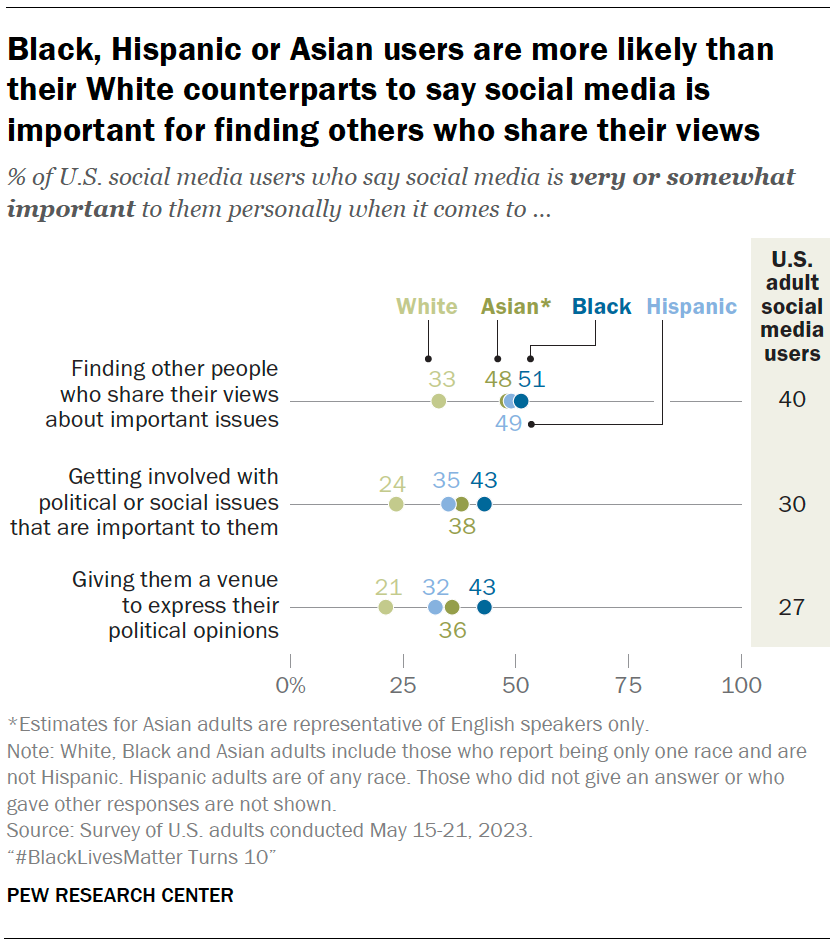
If Black voters are the most likely to mobilize but much of the content on X is racially targeted, this may have implications for voter mobilization.
The sentiment towards social media political engagement among all users has decreased overtime. 82% of users surveyed believe that social media, “distracts people from issues that are truly important,” and 76% believe that it, “makes people think they’re making a difference when they really aren’t,” (Pew 2023).
In a study done by Giulio Corsi, low-credibility and high-toxicity content on X as measured by Jigsaw’s Perspective API over a 14 day period in January 2023 achieved higher visibility on the platform than high credibility and low toxicity content. The study confirmed, “ the existing understanding that toxic content may be more easily amplified by engagement-based recommender systems,” (Corsi 13).
If users are interacting with a specific term like “maga,” the most popularly tweeted hashtag, or “biden,” the most popularly tweeted term, the more they interact with it the more it will show up on other users’ suggested X content as well. And if posts with high emotional sentiment and targeted hashtags are engaged with most, the result is a positive feedback cycle that leads to the increasing sentiment polarization throughout the course of the campaign that Fig. 3 demonstrates and the findings in Rho et. al about comment emotional temperance corroborate.
Musk’s role in the circulation of sentiment for Harris is an important factor to consider in analyzing X data, especially when it comes to designing the engagement-based recommender system available on X. The findings that the most liked and engaged with tweets in both the May and August data as well as those posted the day of the election come from predominantly right-leaning accounts supports Ye et. al and Graham et. al’s findings that the algorithm favors these accounts. “Weeks into Musk’s tenure, the app reportedly restored over 62,000 accounts previously suspended for policy violations in an action that Musk called “general amnesty.” Some of them were white nationalist and neo-Nazi accounts or accounts that repeatedly boost conspiracy theories,” (O’Sullivan 2024). One of the largest X communities is the Election Integrity Committee, created by Musk’s own super PAC, America PAC. According to CNN, this X community is automatically added to a list of feeds that users first see when they join X and has been largely in support of pro-Trump content on the platform throughout the 2024 election cycle. Moreover the introduction of Grok, an AI chatbot created by Musk himself, as free to X users may tilt them towards this content or disseminate content aligning with Musk’s own views poses context for the data that is interesting as well. The, “story for you,” feed allows users to see paragraph-long content describing specific issues created by Grok. In August, five secretaries of state asked Musk to implement changes to Grok as it was known to spread misinformation about Harris casting late ballots in five US states. Unlike other Open AI software, Grok is trained on tweets and is not trained to turn down questions about sensitive political information.